

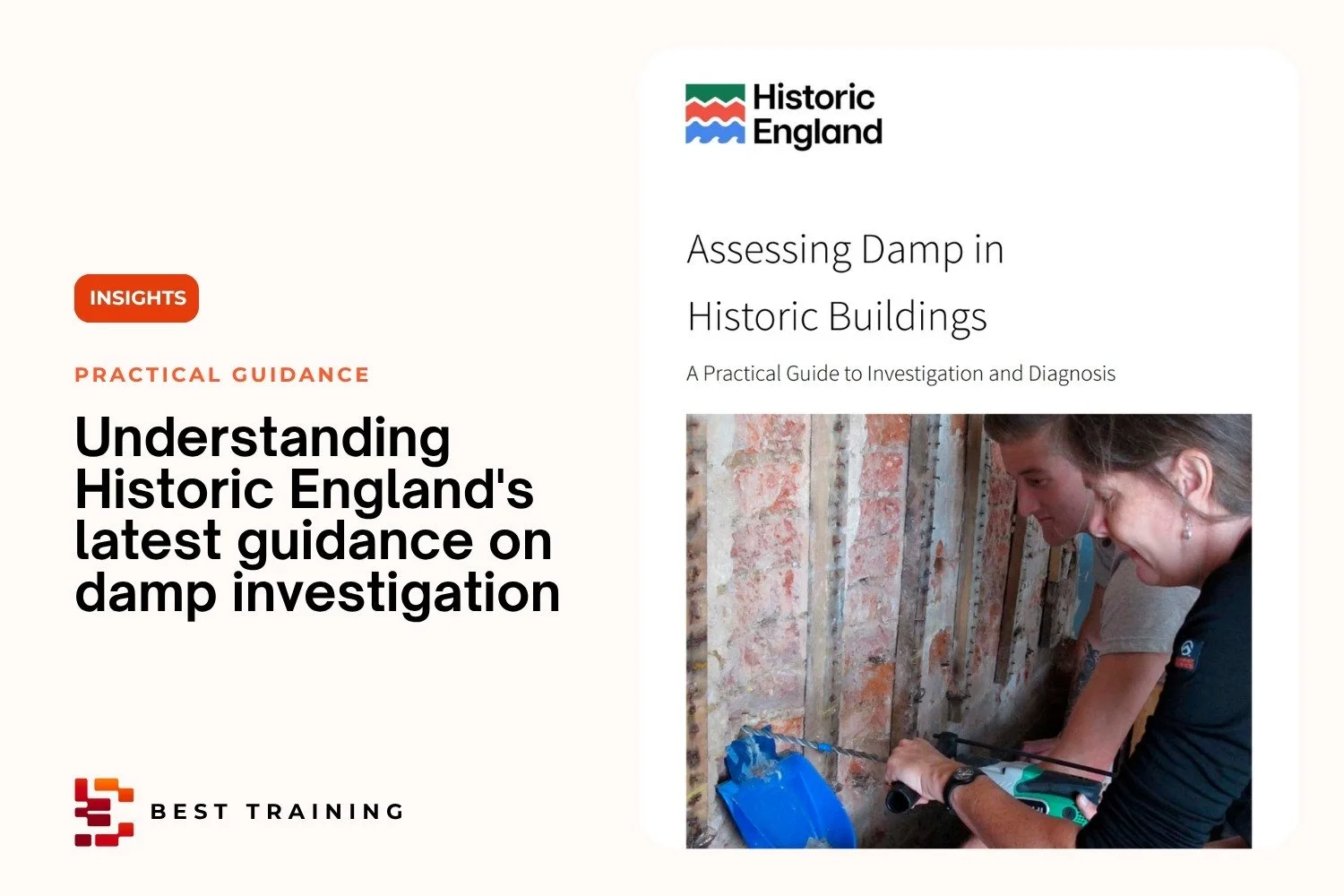
On 13 July 2026, Historic England published Assessing Damp in Historic Buildings: A Practical Guide to Investigation and Diagnosis, a comprehensive 92-page guide written by Dr Brian Ridout and Iain McCaig for conservation professionals, surveyors, contractors and anyone responsible for inspecting traditional buildings.
The publication represents an important step forward in professional guidance on damp investigation. Rather than focusing on symptoms or quick diagnoses, it encourages a more thoughtful, evidence-based approach that considers the building as a whole.
For anyone working with older or traditionally constructed buildings, it is essential reading. And for those looking to develop these skills through practical learning, the principles are closely reflected in Module 2: Investigating Moisture in Traditional Buildings from BEST Training.
What does the guidance cover?
The document is divided into three core areas, supported by detailed case studies and technical references.
Understanding building physics
The guide begins by explaining how moisture behaves within traditional buildings, exploring how water moves through breathable materials such as stone, brick, lime mortar and timber. It highlights why historic buildings manage moisture very differently from modern cavity wall construction and why understanding this behaviour is fundamental to accurate diagnosis.
Investigating damp properly
The second section focuses on investigation techniques, demonstrating how surveyors should approach a building systematically rather than jumping to conclusions based on isolated symptoms. It encourages professionals to consider the building's history, construction, maintenance and environment before reaching a diagnosis.
Understanding the limitations of moisture meters
Perhaps the most valuable section examines the range of equipment commonly used during damp investigations, including resistance moisture meters, capacitance meters, thermal imaging and ground-penetrating radar.
Rather than dismissing these tools, Historic England explains how each has strengths and limitations, and why results should always be interpreted within the wider context of the building.
The publication concludes with four practical case studies, including investigations into a Victorian basement in London and an eighteenth-century orangery, demonstrating how careful observation and systematic investigation lead to accurate diagnoses.
Three important lessons every surveyor should take away
Rising damp is often over-diagnosed
One of the most striking observations within the guidance relates to rising damp.
Historic England references Building Research Establishment research covering around 1,500 damp investigations, which found that genuine rising damp accounted for only around 4% of cases. In most situations, moisture found at the base of walls was linked to issues such as leaking drainage, defective rainwater goods, plumbing defects or raised external ground levels.
It serves as an important reminder that visible symptoms rarely tell the whole story.
Moisture meters don't actually measure moisture
The guidance is refreshingly honest about one of the industry's most misunderstood tools.
Most handheld moisture meters do not directly measure moisture content within masonry. Instead, they measure electrical resistance or dielectric properties and convert those readings into estimated moisture values.
Those readings can be influenced by soluble salts, different construction materials, surface contamination and even the pressure applied by the operator.
Historic England also notes that much of this technology was originally developed during the 1920s for monitoring kiln-dried timber—not historic masonry.
Professional judgement remains the most valuable tool
The strongest message running throughout the guidance is that no single instrument can replace experience and methodical investigation.
Successful damp diagnosis depends on understanding how a traditional building was designed to perform, recognising how it has changed over time and interpreting evidence from multiple sources rather than relying on a single reading.
In short:
Don't diagnose the stain. Diagnose the building.
Why this matters
The publication reinforces a wider shift already taking place across the conservation sector.
Over recent years, organisations including Historic England, RICS and other professional bodies have increasingly promoted evidence-led investigation over assumptions and routine remedial treatments.
For surveyors, conservation professionals and contractors, this guidance provides further confidence that careful investigation, sound building pathology and informed professional judgement remain the foundation of good practice.
Where Module 2 fits in
These are exactly the principles explored throughout Module 2: Investigating Moisture in Traditional Buildings.
Rather than relying on a single moisture meter reading, the course teaches a structured approach to investigation, helping professionals understand how moisture behaves, identify the true causes of damp and make confident recommendations based on evidence rather than assumption.
Through practical demonstrations, real case studies and step-by-step investigation techniques, Module 2 helps bridge the gap between guidance and day-to-day surveying practice.
Historic England has provided the latest evidence. Module 2 helps you put that evidence into practice.
Further Reading
Read the full Historic England guidance:
https://historicengland.org.uk/images-books/publications/assessing-damp-historic-buildings/
Find out more about Module 2 – Investigating Moisture in Traditional Buildings:
https://www.thebesttraining.co.uk/investigating-moisture-in-traditional-buildings